Going Down the Road to Church
After the war, my family emigrated from Cape Breton to Ontario. My father, Dan Alec MacKinnon, a Gaelic-speaking carpenter, “went down the road” first to work on the expansion of Malton Airport. Built in 1937, by 1952 it needed to be enlarged. When the project was completed in 1958, the airport was renamed Toronto International Airport.
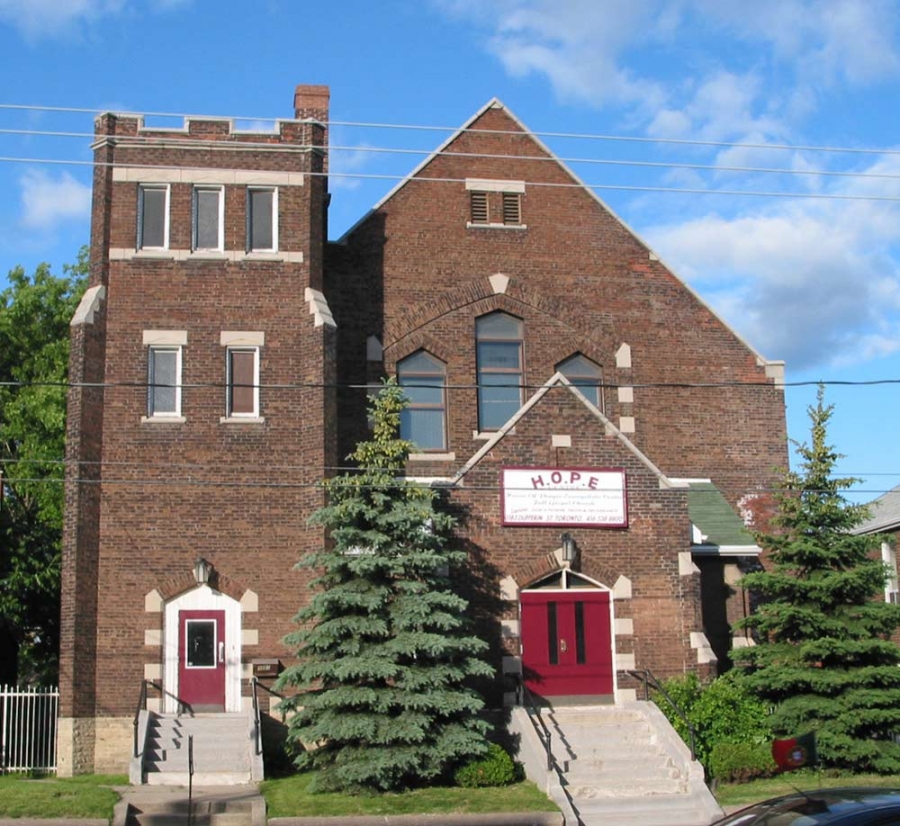
Within a year, Mummy (Dorothy), my brother Johnny and I boarded a train for Toronto. By the mid-fifties, we were settled on Lappin Ave. I was enrolled in Grade 4 at Pauline Public School and attended Sunday School at Dufferin Street Presbyterian Church. In those days, before TV and Sunday sports gripped the province, churches were the hub of a neighbourhood’s social life.
The service had a Scottish flavour
Sunday services began with a historical Highland Scots tradition. The Chief Elder came into the sanctuary to scan the congregation and ensure there were no Papist or English spies lurking in the pews. Then the Bible was ceremoniously carried in, in a wooden box, as we sang Hymn 227, Holy, Holy, Holy. The service ended with the Mizpah Benediction: “May the Lord watch over me and thee while we are absent one from the other.” (Genesis 31:43)
Yearly, I was rewarded with books for perfect Sunday attendance. I still have a few, including Good Wives by Louisa May Alcott, and Every Girl’s Mystery Stories. I also sang in the Junior Choir, robed in a white gown with a big black bow and scholar’s hat. I adored the annual Christmas Candlelight Service when the church was aglow with flickering light and the junior choir warbled “Once in Royal David’s City.”
Saturday mornings were fun
Choir practice was on Saturday morning and so was Cubs. So on Saturdays my brother Johnny and I headed for the church. We each had a nickel and en route to Dufferin St., we stopped at Del’s Bakery at the corner of Lappin and Emerson Aves. I always bought a maple-frosted yeast doughnut — a big treat. Sometimes Mummy sent me to the bakery to buy meat pies for supper. Another special treat was fish and chips, purchased at the fish shop on Lansdowne Ave. To this day, the smell of vinegar, frying fat, haddock and greasy newsprint is as evocative to me as les madeleines were to Proust.
Wednesday evenings I went to Explorers at the church, and ultimately graduated to CGIT — Canadian Girls in Training, or as we used to say, naughtily, the Cutest Girls in Town.
Finding some best friends
My best friends from choir and Sunday School were Marilyn Anderson and Jean Rock. In the summers, we would sit on Jean’s veranda on Wallace Ave., plucking tinny-sounding guitars and singing “A Letter Edged in Black” by Hank Snow and our favourite, “A White Sport Coat and a Pink Carnation.”
The church basement was the venue for all fundraising events, organized by the Women’s Association for Presbyterian missionary work in Formosa — now Taiwan. Mummy was the secretary and at bazaars she always “manned” the white elephant table, where you could buy items that had been donated. I still have collectables garnered at her tables for a nickel or dime, saved from my weekly allowance.
Food was a shared focus
Church teas featured card tables set with handmade embroidered cloths, bone china and silver plate. People were served, for their 25 cents, buttered chop suey loaf, piles of cookies, and what we called “church-basement sandwiches,” which included peanut butter and banana pinwheels, coloured cream cheese triangles, and asparagus rolls. These tea sandwiches were made with thinly sliced sandwich loaf according to the instructions in Kate Aitken’s Canadian Cook Book. From the 1930s and into the 1960s, Aitken was the Queen of the kitchen and the Canadian airwaves — she makes Martha Stewart look like a culinary slacker.
I also recall Sunday school picnics. Always there was potato salad, boiled ham, orange Freshie, assorted home-made pies, as well as three-legged and potato sack races.
At bake sales, my mother’s date squares and fudge were always huge hits. Dorothy started making her Cape Breton fudge in the late 1920s, in a draughty house on Whitney Pier, outside of Sydney. Some things travel well.