Growing Up Above the Parkdale Café
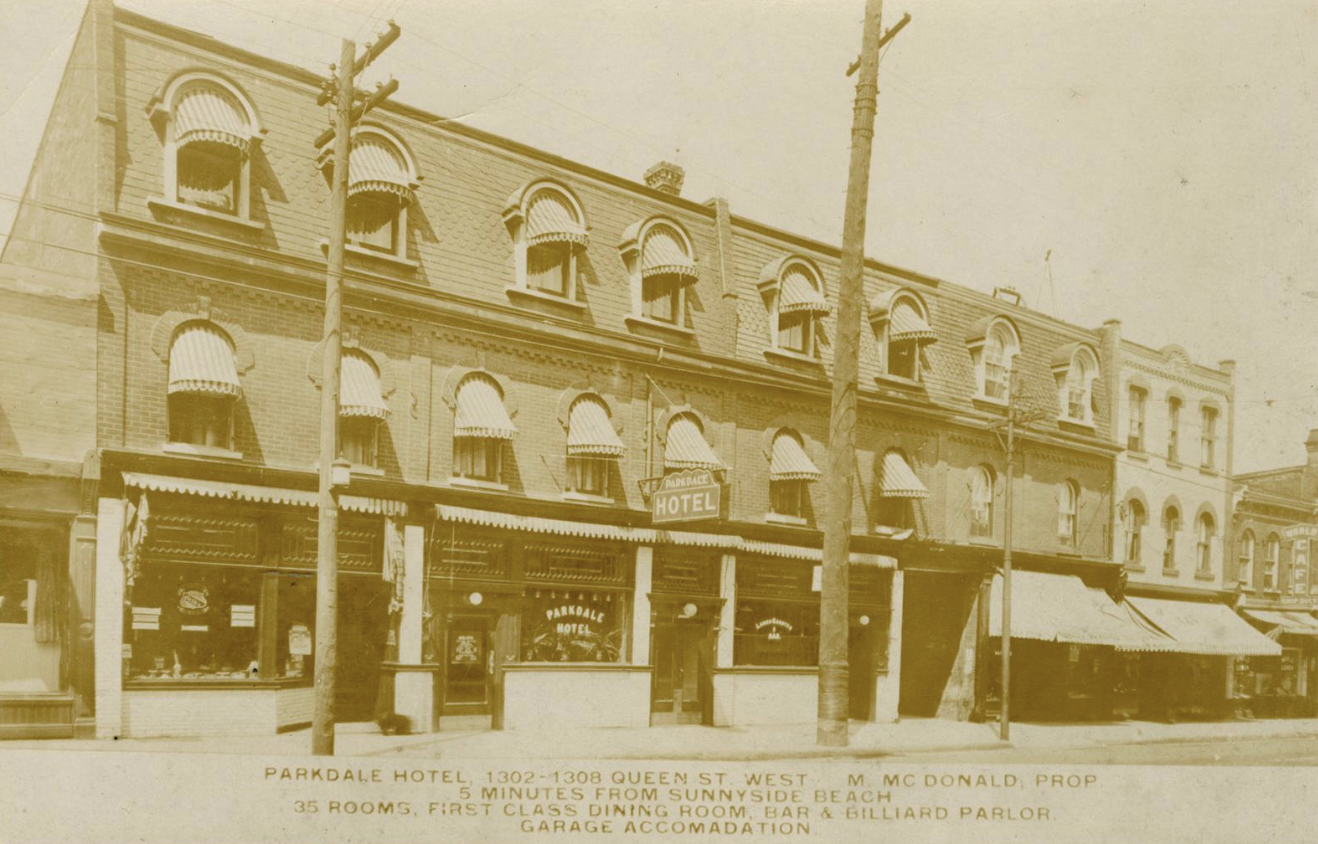
“It was near the Parkdale Hotel. I did cash and took orders. Men would order takeout breakfast in cardboard boxes.”
Life at the café
The café was a classic 1940s diner with booths, a low counter stools, and a Wurlitzer jukebox, featuring hits sung by stars such as Patsy Cline. Saloon-style swinging doors led into the kitchen, where the cook prepared diner favourites, including hot beef sandwiches with gravy and peas. Doreen remembers her daily tonic, cod liver oil mixed into orange juice, served in tiny restaurant glasses.
Doreen’s father, a Chinese immigrant from Guangdong Province, journeyed to Canada during Chiang Kai-shek’s regime (1928–1949). His father, “Harry One,” preceded him and opened the café; when Harry One died, Doreen’s father Harry Louie, known as “Harry Two,” inherited the business.
Doreen’s mother, June, the eldest child, had to leave school to mind her younger siblings. At 17, she was waitressing at the Parkdale Café, and eventually Harry Two and June married and lived above the café. Doreen was born at Mount Sinai Hospital when it was on Yorkville Avenue; four years later, the Louies had another daughter.
Growing up in Parkdale
Doreen’s grandmother lived at 64 Fuller Avenue, where the girls went for daycare. Doreen’s maternal family were Protestants from Northern Ireland; her Irish grandfather emigrated to Canada in 1911, his passage paid for when his father sold a pig. The Louie girls attended Parkdale Baptist Church with their grandma, and Doreen says she is forever thankful for the teachers and churches that gave her life “structure.”
Doreen’s playmates all lived above the businesses along Queen Street — Flossie’s father ran a variety store, Donna’s mother sold women’s wear, Ruth’s father was the local barber, and Jackie Grossman’s father had a haberdashery store.
“I was in competition with Jackie to sit at the top desk as the smartest pupil in the class,” Doreen recalls. (In the 1950s, pupils were seated according to marks, the slowest stigmatized at the back of the room.)
Doreen’s dad had a sewing machine and made dresses and coats for his daughters. “One Easter Sunday, we both had new wool coats — one pink and one blue — and new straw hats. We were taken to the annual Easter Parade on the boardwalk at Sunnyside.”
One day, Mrs. Louie learned that her husband had a family in China. She left the marriage, taking her younger daughter.
“My mother and sister stayed with my grandmother, who had remarried and was living on Perth Avenue. I stayed with my father. I slept in a room on the third floor, with a sink and mirror. I used the restaurant’s ladies’ room.”
By then, Doreen was in Grade 7 at Parkdale Public School, and was told she was “very good at handwriting.”
A new household
After her father died, the café closed, and Doreen went to live with her now-remarried grandma on Perth Avenue. The new grandpa was one of 22 children, including three sets of twins, and worked for the city on garbage trucks, making $28.30 per week. Doreen’s inheritance from her father was his treadle sewing machine.
Soon, Doreen’s mum remarried, bought a house, and her daughters moved in with her on Symington Avenue. By then, Doreen was ready for Bloor Collegiate Institute.
Doreen has never forgotten Miss Whyte, the Grade 9 home economics teacher. “I learned sewing skills from her. We sewed blouses on machines. I also remember embroidering strawberries on a tea towel.”
Another memory: going with Bloor C.I. pals to Vesuvio’s, where they were introduced to pizza pie. “I had never seen a green pepper until then.”
While at Bloor, Doreen worked part-time at Bell Telephone, then attended the University of Toronto and teachers’ college. She married and taught for four years until she became pregnant. Later, she volunteered and worked part-time at various non-profits, including a group home for autistic children and a women’s shelter, eventually becoming the shelter’s Executive Director and serving there for 22 years.
A life of quiet principle
Doreen was nominated for an Order of Canada for her community work but turned it down on principle, believing a lavish, first-class trip to Ottawa for a reception and a golden pin was a waste of money — better used to help the needy.
Recently, Doreen made a scrapbook for her children and grandchildren about the Louie family history, which involved locating her father’s grave. He is buried in Mount Pleasant Cemetery; on the marker, his name appears as Louie Yuen. He was 52 when he died.
“My father had a lot of respect in the city, because he spoke English well and acted as an interpreter,” Doreen says. “When he died, my mother received a letter of condolences from Nathan Phillips, the Mayor of Toronto, for my father’s contribution to the Chinese community.”