The Lasting Glow of Artistic Glass
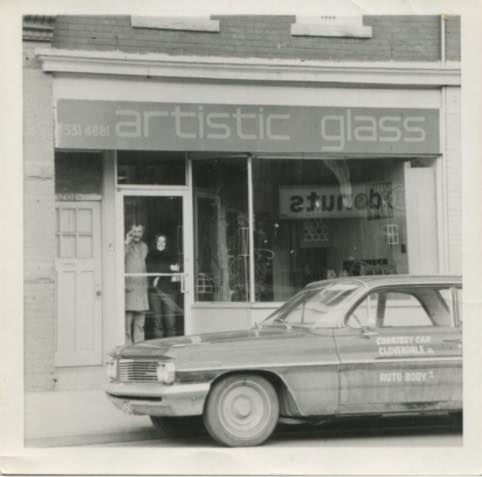
Since 1969, stained-glass displays in the showroom windows of Artistic Glass at the corner of Dundas Street West and Golden Avenue cast a warm glow across the Roncesvalles neighbourhood.
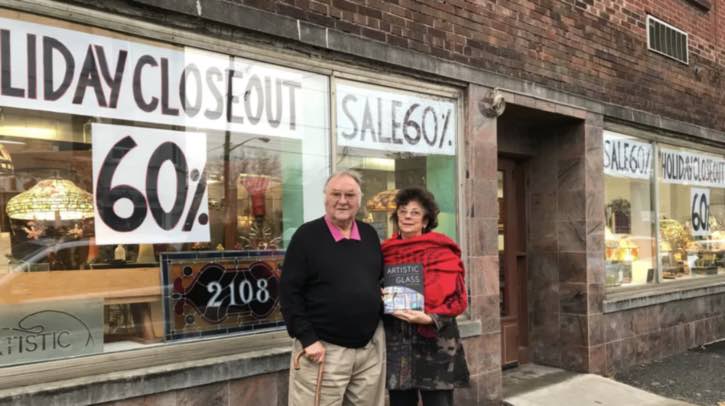
But on Christmas Eve 2021, it all went dark. Owners Josef and Annette Aigner retired after five decades at the corner, closing one of Toronto’s last stained-glass studios.
Josef Aigner was one of Canada’s last stained-glass master craftsmen. His work appeared in private homes — including singer Gordon Lightfoot’s — as well as condominium entrances, hotels, restaurants, private clubs, corporate offices and Niagara Falls’ Fallsview Casino, his largest project.
Churches appreciated Aigner’s craftmanship
Much of his work, however, was created for churches and places of worship across the Greater Toronto Area and southern Ontario. By 2019, he had completed more than 265 church projects. Some, including his 100-panel depiction of The Sermon on the Mount at Mississauga’s St. Francis Xavier parish, became local landmarks.
His studio also completed private commissions around the world, including in the United Arab Emirates, the U.S., Venezuela, China, Japan, Europe and the Caribbean.
Trained in Germany, Josef came to Canada in 1968 during a world tour and decided to stay after arriving in Toronto via the Don Valley Parkway in spring bloom.
He set up a workshop outside his small apartment on Palmerston Boulevard. Just over a year later, he made his first major sale after displaying his work at the Canadian National Exhibition. The owner of the Bandshell restaurant ordered 20 stained-glass lamps. Josef completed them in four days and used the $1,000 payment as a down payment on 2108 Dundas St. W., where he lived and worked.
He later married Annette, a French-Canadian from Kirkland Lake, Ont. Together they bought the neighbouring building at 2106 Dundas Street West and, in 1975, the corner building at 2112 Dundas Street West, previously owned by an egg merchant.
“Josef liked the west end,” Annette recalled. “He made many German friends there.”
Artistic Glass employed local craftspeople
Many were skilled tradespeople themselves — carpenters, welders and even another stained-glass artist. Josef worked alongside them as he expanded the business through commissions generated at trade shows including the CNE Arts and Crafts Building, the Interior Design Show and the National Home Show. He also visited churches directly, asking whether they needed stained-glass work, and approached homeowners in Forest Hill and Rosedale about repairing or replacing stained glass in their homes.
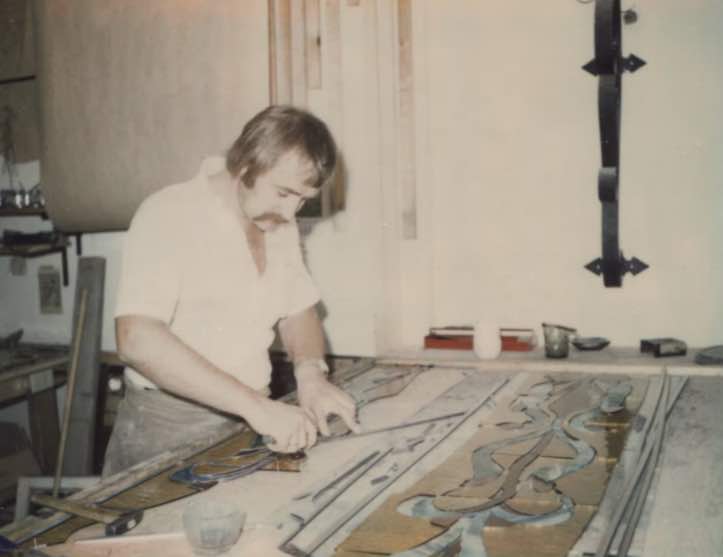
The heart of the business was the workshop and studio Josef and Annette created on two floors above their three storefronts. It became a hub of craftsmanship and creativity, employing between eight and 15 people, many learning on the job. Josef met directly with clients and transformed ideas into finished works of art, carefully considering light, shadow, colour and texture in each project.
“My dad could envision things that were enormous,” said his daughter, Cloe. “Like putting thousands of pieces of glass together to create something beautiful. He could plan things like that in his mind.”
The studio employed artists and craftspeople, some of whom worked there for decades. Once a design was approved, staff created three full-size paper cartoons, or drawings. Two were used as patterns for cutting and painting the glass, while the third was stored for reference.
Artistic Glass also embraced modern production methods, using large tilting glass-cutting tables, sandblasting stations, bevelling stones and industrial kilns that allowed for technical innovation.
The Aigner family lived above the business
In 1978, while Annette was pregnant with their second child, Josef hired an architect to design a European-style home on the third floor above the store, studio and workshop. The buildings were later unified with stucco exteriors, and in May 1979 the family moved in. Their children — Natalie, Cloe and Josef Jr. — grew up there.
The arrangement meant Josef and Annette were never far from either work or family. Over time, the business itself became an extension of family life, with Annette often preparing large Saturday lunches for staff working in the studio and workshop.
“It was always exciting,” Annette said.
In 1982, the couple opened A.J. Stained Glass Supply in their original storefront, selling glass and supplies to the growing community of stained-glass hobbyists. Customers could watch staff working on smaller commissions at a central worktable, and the couple eventually began offering classes. For a time, it became one of the busiest stained-glass supply stores in the city.
The popularity of stained glass was already on the wane when Canada was hit by recessions in 1981 and 1991, followed by the housing market crash in 2008. Josef kept the business going through private commissions and church projects.
In 2019, Josef and Annette decided to close. It was difficult for them, though they had built a lasting legacy.
In 2021, Cloe Aigner published Artistic Glass: One Studio & Fifty Years of Stained Glass (ECW Press).
“In my research,” she said, “I’ve found that stained glass endures.”
Where to see Josef Aigner’s work
The work of artist and master craftsman Josef Aigner can be found in private homes and public spaces throughout the world, with many publicly accessible works located in southern Ontario. Notable examples include:
- Christ the King Church, Mississauga, Ont. — Cosmic Vision of Christ, an illusion of three-dimensional stars, planets and galaxies.
- Consolata Missionaries, Vaughan, Ont. — Depictions of Mother Teresa and St. Kateri Tekakwitha.
- Jesuit Martyrs Shrine, Midland, Ont. — A scene depicting Huron Chief Joseph Chiwatenhwa and Jesuit missionary Jean de Brébeuf in a 1630s clear-cut forest.
- Old Spaghetti Factory, Toronto — The 1993 World Series champion Toronto Blue Jays superimposed on a scene of Jesus and the Apostles.
- Knox Presbyterian Church, St. Catharines, Ont. — Let the Children Come Unto Me, a two-storey window depicting children running uphill toward Jesus. Visitors can climb the adjoining staircase to stand level with the figure of Jesus.
- Queen of Heaven Catholic Cemetery, Woodbridge, Ont. — Three mosaic walls.
- Newman Centre Catholic Mission, University of Toronto, Toronto — Twelve windows honouring contemporary Christian figures, including Archbishop Oscar Romero and former governor general Georges Vanier and his wife, Pauline.
- Sephardic Kehila Centre, Thornhill, Ont. — Stories from the Torah.
- Princess Margaret Hospital chapel, Toronto — A serene landscape featuring two musicians and two lovers.
- Brock University, St. Catharines, Ont. — Donor walls featuring the etched face of Maj.-Gen. Sir Isaac Brock.
- Sherlock Holmes Collection, Toronto Reference Library, Toronto — Four custom stained-glass windows containing 114 clues drawn from the Sherlock Holmes stories.
- Fallsview Casino Resort, Niagara Falls, Ont. — Five domes in the main gaming hall made from 975,000 pieces of stained glass.
- Hilton Hotel, Niagara Falls, Ont. — A flowing curved-glass handrail and banister installation.
Sources:
Interview: Annette Aigner, January 14, 2022
Interview: Cloe Joël Aigner, January 17, 2022
Artistic Glass: One Studio & Fifty Years of Stained Glass. Cloe Joël Aigner. ECW Press 2020.